
Small businesses rarely have a technology problem in isolation.
They have an invoice that takes too long to approve. Customer information sits in different spreadsheets. Stock levels are checked manually. Employees repeat the same administrative work every week. Management cannot see cash flow or sales performance until someone prepares a report.
Technology matters because these problems matter.
Digital transformation for SMEs in Saudi Arabia is not about copying the technology environment of a large enterprise. Small and medium businesses need a more focused approach: identify where manual work or fragmented information is limiting the business, introduce the right digital solution and expand only when the result justifies the next investment.
That approach is particularly relevant in 2026 as Saudi Arabia’s SME ecosystem continues to expand and national initiatives encourage smaller businesses to adopt digital technologies, artificial intelligence and more innovative operating models.
For an SME, transformation does not need to begin with a large IT budget.
It needs to begin with the right problem.
Why Digital Transformation Matters More as Saudi SMEs Grow
Saudi SMEs now represent a substantial part of the private-sector economy.
According to the Saudi Vision 2030 Annual Report 2025, the number of SMEs in the Kingdom has exceeded 1.7 million. They employ around 8.8 million people and contribute 22.9% of GDP.
Growth creates opportunity.
It also exposes operational weaknesses.
A spreadsheet that worked for 20 customers may become difficult to manage at 2,000. An approval process that was simple with five employees can become a bottleneck when several departments are involved. A founder who once knew every transaction personally eventually needs reporting systems instead of memory.
Digital transformation helps an SME build operational capacity before manual processes become a constraint on further growth.
What Does Digital Transformation Mean for an SME?
For a small or medium business, digital transformation means using technology to improve how the company operates, serves customers, manages information and makes decisions.
That can involve:
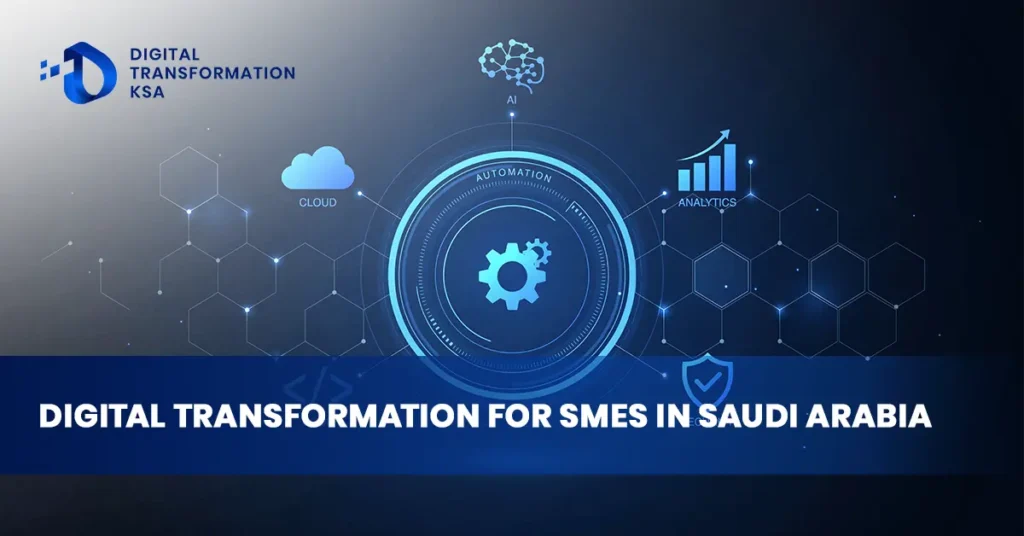
Cloud platforms: Moving appropriate applications and information into scalable, accessible digital environments.
Automation: Removing repetitive administrative steps from workflows.
ERP or accounting systems: Creating more structured financial and operational processes.
CRM: Organising customer information, sales activity and follow-up.
Analytics: Turning transactions into useful performance information.
AI: Supporting tasks such as document processing, forecasting, customer service or knowledge work.
The important point is that an SME does not need all of these at once.
Transformation should follow business priorities.
SMEs Should Not Copy Enterprise Digital Transformation
A large corporation may have an internal IT department, cybersecurity specialists, data teams, enterprise architects and a substantial transformation budget.
Most SMEs do not.
Trying to reproduce the same transformation programme on a smaller budget usually creates unnecessary complexity.
An SME needs to be more selective.
If the immediate problem is late customer follow-up, a properly implemented CRM may matter more than an enterprise data platform.
If finance spends days processing invoices, workflow automation may create greater value than a sophisticated AI programme.
If management cannot see inventory accurately, the priority may be integrated inventory and accounting rather than another customer-facing application.
SME digital transformation in KSA should therefore be proportionate to the organisation’s size, risk and operating needs.
The objective is not to own more technology.
It is to remove constraints on the business.
Where Should an SME Start?
A useful starting point is to identify where employees repeatedly lose time.
Look at processes that depend heavily on spreadsheets, email, paper, messaging applications or repeated data entry.
Then ask three questions:
Where does work wait?
Where is information entered more than once?
Where does management lack visibility?
The answers often reveal the first digital priorities.
For one business, the issue may be finance. For another, inventory. For a third, customer management.
There is no universal first transformation project.
Start With the Financial Core
Finance is one of the strongest starting points for many SMEs because almost every business process eventually affects financial information.
Manual bookkeeping, disconnected invoicing and spreadsheet-based expense tracking become increasingly difficult as transaction volumes grow.
A modern accounting or ERP environment can bring greater structure to receivables, payables, expenses, reporting and financial records.
The objective is not simply to digitise accounting.
It is to create a financial foundation that can connect with other business processes later.
Sales, procurement, inventory and payroll information can become significantly more useful when they ultimately connect to reliable financial data.
Move Customer Information Out of Individual Inboxes
Customer relationships become difficult to manage when information belongs to individual employees instead of the business.
One salesperson maintains a spreadsheet. Another stores notes in email. A manager tracks opportunities separately.
When an employee is unavailable, the customer history becomes difficult to reconstruct.
A CRM can create a shared record of customer activity.
Sales teams can track opportunities, follow-ups and interactions through a defined process rather than personal reminders.
This becomes especially valuable as the business grows.
The SME gains organisational memory.
Customer knowledge remains available even when employees or responsibilities change.
Automate Repetitive Work Before Hiring Around It
Growing businesses often respond to increased administrative work by adding more employees.
Sometimes that is necessary.
Sometimes the process should be automated first.
Consider a business where an employee receives customer orders by email, copies details into a spreadsheet, updates an accounting system and sends the same information to operations.
Increasing order volume creates more administrative work because the process itself does not scale.
SME automation can reduce these repeated steps.
Information entered once can trigger subsequent actions, update connected systems or create tasks automatically.
This does not mean every process should become autonomous.
It means employees should not spend time repeatedly moving information when systems can perform that movement reliably.
Cloud Platforms Can Reduce the Infrastructure Barrier
SMEs historically needed significant upfront investment to access sophisticated business technology.
Cloud computing has changed that model.
Many accounting, CRM, collaboration, analytics and ERP applications can now be accessed as cloud services without an SME maintaining the complete underlying infrastructure itself.
This can make technology easier to adopt progressively.
A business can start with a small number of users and expand as requirements change.
Cloud applications can also support employees working across different offices or locations.
But cloud does not remove the need for management.
Businesses still need to consider access, cybersecurity, data, backups, integration and cost.
The advantage is flexibility, not the disappearance of IT responsibility.
Digital Tools Should Connect as the Business Grows
An SME can easily replace one manual problem with several disconnected digital systems.
Finance uses one application. Sales chooses another. HR subscribes to another platform. Operations maintains spreadsheets because none of the systems fit its workflow.
Each department becomes more digital.
The company remains fragmented.
This is why integration needs to become part of the transformation roadmap.
Not every system needs to be replaced by one giant platform.
But important information should be able to move appropriately between systems.
Customer orders may need to connect with invoicing. E-commerce may need to connect with inventory. HR information may need to connect with payroll.
A good digital environment reduces duplicate entry rather than creating new places to enter the same information.
Data Analytics Does Not Need to Start With a Data Science Team
SMEs need data just as much as larger organisations do.
They often need less complexity.
Management may initially need answers to a small number of questions:
How much are we selling?
Which products generate the strongest margins?
Which customers owe us money?
How quickly is inventory moving?
Where are expenses increasing?
Which sales opportunities are likely to close?
If information is captured consistently across the business, relatively straightforward dashboards can already improve decision-making.
The important step is creating trusted data.
A complex analytics platform built on inconsistent spreadsheets will not solve the underlying problem.
For an SME, good business technology should make important information easier to understand, not create another reporting burden.
Where AI Fits Into SME Digital Transformation
AI is becoming more accessible to smaller businesses.
That does not mean every SME needs an AI transformation programme.
The strongest starting points are usually specific tasks where AI can create a measurable improvement.
An AI application may help classify incoming enquiries, extract information from documents, summarise business information, support customer service or assist employees with internal knowledge.
AI can also complement automation.
A traditional workflow might route a form according to fixed fields. AI can help interpret less structured information before the workflow continues.
Saudi Arabia is actively encouraging this adoption.
In August 2026, Monsha’at and SDAIA ran AI Week to help entrepreneurs and SME owners understand AI technologies, applications and enabling services. More than 3,900 beneficiaries participated, with sessions covering how AI can be used in products, services and business operations.
The direction is clear.
But the SME still needs a business case.
AI should solve a problem, not become the problem the company is trying to find a use for.
A Practical Digital Transformation Stack for SMEs
Different stages of growth require different digital capabilities.
| Business need | Possible digital capability |
| Financial control | Cloud accounting or ERP |
| Customer management | CRM |
| Repetitive administration | Workflow automation |
| Team collaboration | Cloud productivity tools |
| Online selling | E-commerce and payment integration |
| Management visibility | BI dashboards and analytics |
| Growing data volumes | Structured data management |
| Intelligent assistance | AI-enabled tools |
| Digital protection | Cybersecurity controls |
This is not a shopping list.
An SME should not implement every category because it appears in a transformation framework.
Each investment should correspond to an actual operational requirement.
How to Build an SME Digital Transformation Roadmap
A smaller business can transform incrementally without losing strategic direction.
1. Identify the Operational Bottleneck
Start with a process, not a software category.
Map where employees lose time, errors occur, customers experience delays or management lacks information.
Quantify the problem where possible.
2. Establish the Business Outcome
Define what should improve.
That could mean reducing invoice-processing time, improving inventory accuracy, responding to leads faster or producing management reports without manual consolidation.
A clear outcome creates a basis for measuring the project later.
3. Check Existing Technology
The business may already own functionality it is not using.
An accounting platform may include approval workflows. A CRM may contain automation features. A cloud productivity suite may already provide collaboration tools.
Using existing capabilities can sometimes solve the problem without adding another subscription.
4. Choose a Right-Sized Solution
Select technology according to current requirements and reasonable growth expectations.
Buying an overly complex enterprise system can create implementation and training costs that exceed its practical value.
Buying a system that cannot scale at all creates a different problem.
The right solution sits between those extremes.
5. Clean and Organise the Data
Before migrating customer, financial or inventory records, review their quality.
Remove unnecessary duplicates and standardise important information.
New technology should not become a new home for old data problems.
6. Implement One Controlled Change
Pilot the solution with a manageable process, team or location where appropriate.
Observe how employees actually use it.
Fix workflow and integration problems before expanding.
7. Measure Before Scaling
Compare performance with the original baseline.
If the project creates meaningful value, determine what should come next.
This turns transformation into a sequence of evidence-based investments.
How Much Technology Does an SME Really Need?
The answer changes as the business grows.
An early-stage company may operate effectively with cloud accounting, CRM and collaboration software.
A larger SME with inventory, several branches and complex procurement may need ERP, workflow automation and stronger analytics.
The technology environment should mature with operational complexity.
The mistake is assuming sophistication itself creates value.
An SME with six well-integrated systems can operate more effectively than a business paying for twenty platforms that employees barely use.
Every application creates cost, training requirements, data and another relationship to manage.
Technology rationalisation is therefore part of transformation too.
Cybersecurity Cannot Wait Until the SME Becomes Large
Small businesses sometimes assume cyber risk becomes important only after the company reaches enterprise scale.
Digital dependence begins much earlier.
An SME may rely on email, cloud accounting, online banking, CRM and shared documents for daily operations.
A compromised employee account can therefore affect significant parts of the business.
Basic cybersecurity should develop alongside digital adoption.
Protect identities: Use multi-factor authentication and avoid unnecessary administrator access.
Control permissions: Employees should have access appropriate to their roles.
Update systems: Keep supported applications and devices appropriately patched.
Protect information: Understand where important business and personal data is stored.
Maintain recovery: Back up critical information appropriately and know how it would be restored.
Prepare employees: Help staff recognise phishing, suspicious payment requests and unsafe handling of information.
Cybersecurity is not a separate project to begin after transformation.
It is part of making digital operations dependable.
Do Not Ignore Employee Adoption
A technology implementation fails if employees continue performing the old process beside it.
This is particularly important in SMEs because individual working habits can have a large effect on the entire organisation.
If a CRM is introduced but salespeople continue storing opportunities privately, customer information remains fragmented.
If an approval workflow is implemented but managers still approve purchases through messages, the digital process loses its control value.
Employees need to understand why the workflow is changing.
Training should focus on their actual tasks.
Management then needs to use the new process consistently.
Transformation becomes real when the digital workflow becomes the normal way of working.
What Should SMEs Avoid During Digital Transformation?
Smaller organisations have less capacity to absorb failed technology investments, so discipline matters.
Buying before diagnosing: Software is selected before the business problem is understood.
Digitising bad processes: Unnecessary approvals and duplicate steps are transferred directly into a new platform.
Adding too many applications: Each department purchases tools independently and creates another data silo.
Ignoring integration: Employees continue copying information between supposedly digital systems.
Migrating poor data: Duplicate and inconsistent records enter the new environment.
Over-customising: A standard solution becomes expensive and difficult to maintain.
Skipping security: Convenience is prioritised while access and data controls remain weak.
Failing to measure: The business cannot determine whether the investment improved anything.
Avoiding these mistakes is often more valuable than implementing another technology.
How Can Saudi SMEs Measure Digital Transformation ROI?
SMEs need practical measures.
A digital project should change an operational or financial result.
An automation project might reduce administrative hours.
A CRM implementation could improve follow-up rates and sales visibility.
An inventory system may reduce stock discrepancies.
Analytics may reduce the time management spends preparing reports.
Useful measures include:
Process time: How long does the activity take before and after implementation?
Manual effort: How many employee hours are required?
Errors: Has rework declined?
Customer response: Are enquiries or orders handled faster?
Reporting time: How quickly can management access reliable information?
System adoption: Are employees actually using the intended workflow?
Financial impact: Has the project reduced cost, released capacity or supported revenue?
The metric should match the reason the technology was purchased.
Saudi Arabia’s SME Digital Ecosystem Is Becoming More Important
SMEs are central to Saudi Arabia’s economic diversification and private-sector growth.
That is reflected in the scale of the ecosystem.
The Vision 2030 Annual Report 2025 states that the Kingdom now has more than 1.7 million SMEs, compared with more than 429,000 in 2016.
Support is also increasingly extending into advanced technology.
During 2026, Monsha’at continued programmes connecting SMEs with technology, innovation and enabling organisations. Its AI Week with SDAIA brought together more than 40 government, private-sector, educational and technology entities and attracted more than 3,900 beneficiaries.
This matters because digital transformation is no longer an enterprise-only discussion.
Smaller companies increasingly have access to cloud platforms, automation, analytics and AI capabilities that previously required far greater infrastructure.
Access, however, is only the first step.
The competitive difference comes from how effectively those capabilities are applied.
Digital Transformation for SMEs Should Be Small Enough to Start and Strong Enough to Scale
A Saudi SME does not need to transform every department simultaneously.
It needs to know which operational constraint should disappear first.
That may be a spreadsheet-dependent finance process, disconnected customer information, manual approvals, unreliable inventory data or reporting that arrives too late to influence decisions.
Solve that problem.
Connect the solution properly. Protect the information. Train the people who use it. Measure the outcome.
Then decide what deserves to change next.
That is a more sustainable approach to digital transformation for SMEs in Saudi Arabia than purchasing a large collection of technologies and hoping the business becomes digital around them.
For companies working through those choices, Digital Transformation KSA can serve as a practical reference for understanding how automation, cloud platforms, analytics, AI and wider digital transformation fit into the Saudi business environment.
For an SME, the strongest transformation roadmap is rarely the longest one.
It is the one the business can actually execute, measure and build upon.
FAQs
What is digital transformation for SMEs in Saudi Arabia?
Digital transformation for SMEs involves using technologies such as cloud platforms, automation, accounting or ERP systems, CRM, analytics and AI to improve business processes, customer experiences and management decisions. It should be based on the SME’s actual operational priorities rather than adopting every available technology.
Where should a Saudi SME start its digital transformation?
Start with a measurable business problem. Identify repetitive manual work, disconnected information, customer delays or areas where management lacks visibility. The first digital investment should address one of these problems and have a clear outcome that can be measured.
Is digital transformation expensive for small businesses?
It does not necessarily require a large enterprise-level investment. Cloud-based software and subscription models allow many SMEs to introduce digital capabilities progressively. Costs depend on the systems, users, integrations, data migration, implementation and support required.
How can AI help SMEs in Saudi Arabia?
AI can support tasks such as document processing, customer-service assistance, information summarisation, forecasting and workflow classification. SMEs should begin with a specific use case where AI can create measurable value rather than adopting AI without a defined business problem.
What are the most useful digital tools for Saudi SMEs?
The appropriate tools depend on the business. Common foundations include cloud accounting or ERP, CRM, collaboration platforms, workflow automation, e-commerce, analytics and cybersecurity tools. As the SME grows, integration between these systems becomes increasingly important.